en


Exhibition by Marisa Cornejo, "El Taller de la Fragilidad"
On the occasion of her first institutional solo exhibition in Geneva, Marisa Cornejo presents a series of works exploring different experiences of exile and displacement.
What does it mean to return to a country that has continued to exist without you? This question has run through the work of visual artist and writer Marisa Cornejo for several decades. Born in Chile during the Popular Unity government (Unidad Popular, 4 September 1970–11 September 1973) and forced into exile with her family under the military dictatorship, Cornejo does not seek to recover a lost homeland. Instead, her work examines forms of belonging rendered discontinuous, where memory is constructed from fragments—both real and imagined—to which access was long denied.
In Reflections on Exile (1984), Edward Said, who devoted much of his life to reflecting on the political and existential consequences of exile, describes the capacity of exiled subjects to apprehend the world through what he calls a "contrapuntal consciousness," in which multiple temporalities and geographies coexist without ever merging into a single narrative. Marisa Cornejo's photographs seem to inhabit precisely this space. By revisiting, as an adult, places in Chile from which she had been separated as a child, the artist does not stage a return; rather, she documents the distance between memory and the present, between the image and lived experience. This tension finds a particularly compelling material form in Los Tótems de mi Ausencia (The Totems of My Absence), a series of plaster forms that punctuate the floor of Halle Nord. Partially covered with postcards of Chile, these sculptures give physical presence to a memory long confined to the surface of images. Produced from photographs taken by the artist during recent journeys to Chile, these images reactivate emblematic sites whose landscapes have been shaped as much by national narratives as by the tourist imagination. They also draw upon the postcards her grandparents sent her throughout her childhood in exile—static witnesses to a country that remained inaccessible to her. Cornejo describes these stelae as attempts to "heal the flattening that modern chronology has imposed on our history" by giving memories volume, allowing them to occupy space.
The exhibition also resonates with the writings of Franco-Chilean cultural theorist Nelly Richard. In Crítica de la Memoria (1990–2010) (Critique of Memory, (1990-2010), 2010), Richard argues that while Chile's democratic transition did not erase the fractures produced by the military dictatorship, it often concealed them beneath a consensual national narrative. Faced with this gradual erosion of the transmission of memory, art has the capacity to make perceptible the continuities between past and present—a quality exemplified by Marisa Cornejo's literary and visual practice. Whether through her writing, drawings or sculptures, the artist allows us to glimpse, often obliquely, the ways in which this history continues to shape landscapes, objects and bodies.
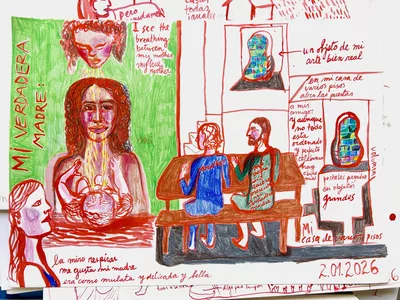
Partly centred on the figure of the mother, the exhibition also presents a selection of Marisa Cornejo's dream drawings and dream paintings. Since 1997—the year of her final exhibition with the collective La Panadería in Mexico City—the artist has recorded her dreams daily in the form of drawings. These works shift this archaeology of memory towards the body. In La Madre que me Enseña a Respirar (The Mother Who Teaches Me to Breathe), memory is no longer organised according to a chronology of events, but according to a logic of sensation and breath. Breathing becomes a genuine critical operation that seeks to undo the flattening produced by trauma, restoring the body's capacity to inhabit space. The dreams thus articulate a non-linear temporality in which individual memory and collective inheritances coexist without hierarchy. Ultimately, Marisa Cornejo's dream drawings, like the body of work brought together in El Taller de la Fragilidad, offer an intimate translation of exilic consciousness: a space where heterogeneous realities no longer seek resolution, but instead learn to breathe together.
Dates and times
from Friday 4 September 2026
to Saturday 10 October 2026
Event location
Address
Halle Nord, Place de l'île 1, 1204 Genève