en


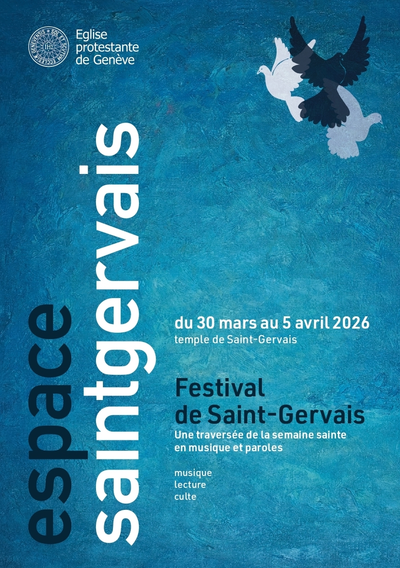
Festival de Saint-Gervais 2026
After a promising first edition, Espace Saint-Gervais has decided to once again embark on organizing a festival in which the experience of spirituality takes on different forms.
** Monday, March 30 at 6:30 p.m.
Music for the Season of the Passion
The musical setting of Christ’s Passion has spanned the centuries since the earliest days of Christianity. A time for meditation and contemplation, the Passion reveals to us a God who becomes human and accepts suffering, in Jesus, in order to save humanity.
To help us enter into this mystery, the Évohé Vocal Ensemble presents a cappella chants and works with cello accompaniment composed in the 20th century.
Works by N. Balbulus, Ph. Hersant, D.-B. György, L. Niedermeyer, Z. Kodály and A. Halloppeua
Évohé Vocal Ensemble
Anna Ozdemir, cello
Fruzsina Szuromi, conductor
** Tuesday, March 31 at 6:30 p.m.
Lecture en résonance
“… and I stand here before life / as before a dress / that can no longer be worn.”
Charlotte Delbo survived the concentration camps where she was imprisoned for two long years. Forever marked by the experience of inhumanity, she leaves us a body of literary work that bears witness to the impossibility of rejoining the company of the living. Among her writings is a series of poems that are true lamentations in the biblical sense — a cry toward a God who seems too absent.
The poems of Claude Roy, another member of the Resistance, read in echo, attempt nevertheless to preserve hope in human solidarity, celebrating its fragile weapons: friendship, literature, rebellion — and, like a slender path toward Easter, denying death the right to have the final word.
“Death, with closed eyes, does not have the last word.”
Rose-Marie Nicolas and Jean-Luc Bideau will share this reading, accompanied by guitarist Guy Hirschberger, who will offer a varied program in keeping with the particular tone of the evening’s texts.
Charlotte Delbo & Claude Roy, authors
Rose-Marie Nicolas and Jean-Luc Bideau, readers
Guy Hirschberger, guitar
** Wednesday, April 1 at 6:30 p.m.
H. I. F. BiberRosary Sonatas
Since 2017, Emmanuelle Dauvin has embarked on an adventure by reviving a remarkable Baroque-era practice: as a violinist, she accompanies herself by playing an organ pedalboard — the “Baroque UFO.”
Her programs therefore create a dialogue between pieces for solo violin and works with basso continuo — a technical feat!
Emmanuelle Dauvin has chosen to perform several of Biber’s Rosary Sonatas, a cycle of fifteen sonatas including The Agony in the Garden, The Crucifixion, The Assumption of the Virgin, and the famous Passacaglia (the longest piece for solo violin before J. S. Bach’s Chaconne).
Heinrich Ignaz Franz Biber, born in 1644 north of Prague and died in Salzburg in 1704, was a violinist and composer. In some of his works he uses scordatura, an “altered tuning” technique that multiplies the possible tunings of a single instrument. The Mystery Sonatas (another name for the Rosary Sonatas) offer fifteen different ways of tuning the violin.
Emmanuelle Dauvin, violin and organ
** Friday, April 3 at 3:00 p.m.
F. LisztVia Crucis
The season of the Passion offers a universal moment of reflection on our mortality, on the meaning of existence, and on hope. On Good Friday, the Way of the Cross illustrates an irreversible journey which does not turn back, but, once the darkness has been passed through, opens onto new hope.
Franz Liszt’s Via Crucis lies at the heart of this program. In fourteen stations, this work — striking in its concentration and radical nature — sets Christ’s Passion to music. In this piece, Liszt, in his later years, turns definitively away from the virtuosity of his early career and becomes a visionary, developing a revolutionary musical language marked by abrupt breaks and silences.
The Zurich Chamber Singers were founded in autumn 2015 in Winterthur and are conducted by Christian Erny. Over the past decade, the ensemble has established itself as one of Switzerland’s few professional choirs. Composed of more than thirty young Swiss and international singers, the ensemble is distinguished by its remarkable versatility and its insatiable curiosity for innovative programming.
The Zurich Chamber Singers
Tamara Chitadze, piano
Christian Erny, conductor
** Sunday, April 5 at 10:00 a.m.
Easter Service with Communion
J. S. BachChrist lag in Todesbanden, BWV 4
The cantata Christ lag in Todesbanden is one of the first Bach composed for Easter Day in 1707 or 1708, at the time when the young musician was about to be appointed organist in Mühlhausen.
After a brief instrumental introduction, the vocal movements take up the seven stanzas of a chorale written by Martin Luther, inspired by a medieval hymn celebrating Christ, the Paschal Lamb, crucified for the salvation of sinners, whose death stripped death of its power: in Him, life prevailed. Although almost all the stanzas mention death, they each conclude with an Alleluia — a cry of trust and joy: Christ is truly risen!
The Saint-Gervais Vocal and Instrumental Ensemble is made up of singers and instrumentalists from the Geneva region, experienced in sacred music and familiar with performance on historical instruments. For 20 years, they have taken part in the monthly cantata services at Saint-Gervais Church and in the Christmas and Easter celebrations, under the direction of Diego Innocenzi, the church’s principal organist.
Saint-Gervais Vocal and Instrumental Ensemble
Diego Innocenzi, conductor
Free admission to all events – collection
Dates and times
from Monday 30 March 2026
to Sunday 5 April 2026
Event location
Location name
Espace Saint-Gervais
Address
Rue des Terreaux-du-Temple 12 - 1201 Genève
Accessibility

Prices and conditions
Price
Free