en


Odyssey Martin and Schubert – Ballads and Winterreise
The Geneva Chamber Orchestra and the Lemanic Modern Ensemble reunite for a concert around Franz Schubert’s « Winterreise » and Frank Martin’s six « Ballades », conducted by Thierry Fischer.
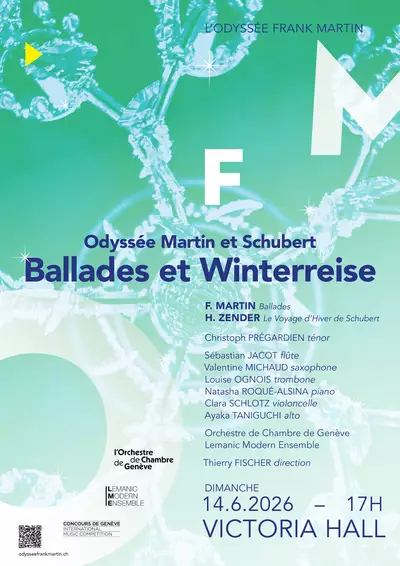
- Program
H. Zender – Schubert’s Winterreise
F. Martin – Ballad for saxophone and orchestra
F. Martin – Ballad for flute and orchestra
F. Martin – Ballad for piano and orchestra
F. Martin – Ballad for trombone and orchestra
F. Martin – Ballad for cello and orchestra
F. Martin – Ballad for viola and orchestra
- Artists
Christoph Prégardien tenor
Sébastian Jacot flute
Valentine Michaud saxophone
Louise Ognois trombone
Natacha Roqué-Alsina piano
Clara Schlotz cello
Ayaka Taniguchi alto
Orchestre de chambre de Genève
Lemanic Modern Ensemble
Thierry Fischer, direction
Schubert’s Winterreise (Winter Journey), composed in 1827 on poems by Wilhelm Müller, is a cycle of 24 songs for voice and piano, regarded as one of the peaks of the repertoire. It traces the wanderings of a solitary traveller through a winter landscape, reflecting a profound inner turmoil marked by solitude, romantic disillusionment, and confrontation with death. In 1993, Hans Zender proposed a “creative transformation” of the work for tenor and small instrumental ensemble with unusual colours, combining symphonic orchestra instruments with more singular timbres such as accordion, harmonica, guitar, or wind machine. This contemporary re-reading does not alter the work’s inner journey but shifts its perspectives, as if the voyage were being rewritten under different lights.
It is in this idea of reinvented musical narration, free form, and inner trajectory that Frank Martin’s cycle of six Ballades resonates. Composed between 1938 and 1972 for solo instruments (saxophone, flute, piano, trombone, cello, viola) and ensembles, the term “ballade” here refers to its Romantic sense: music that tells a story without a fixed programme, leaving the listener complete freedom of interpretation. These works exemplify, in many respects, Frank Martin’s characteristic combination of harmonic mastery, chromatic intensity, rhythmic vitality, and formal clarity. They do not depict a narrative in the literal sense, but rather an inner progression made of fragments, tensions, and ruptures. Like true miniature concertos, they articulate an instrumental voice that is at times lyrical, harsh, or contemplative, where form itself becomes a journey.
Dates and times
Sunday 14 June 2026
Event location
Location name
Victoria Hall
Address
Rue du Général Dufour 14, 1204 Genève - 1204 Genève
Organiser
Proposed by
L'Odyssée Frank Martin